
The Early Warning Signs of Internal Tree Decay Most People Miss
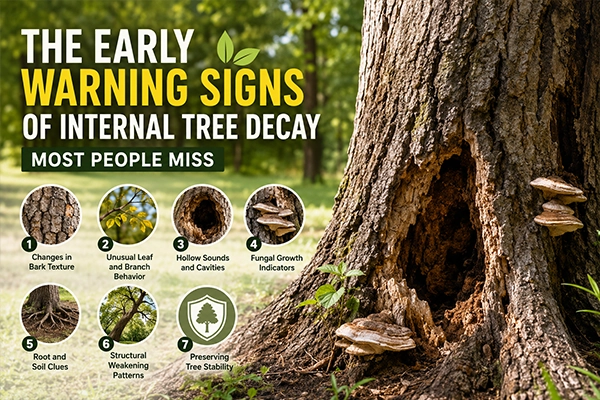
A decaying tree displaying common warning signs such as hollow cavities, fungal growth, and weakened structure
On the outside, trees may look strong and healthy, but on the inside, they may be slowly losing their strength. This kind of hidden damage usually happens over time because of things like pests, uneven moisture levels, physical damage, or stress from the surroundings.
Many property owners don’t notice early warning signs until there is already a lot of damage because the outer bark may still look fine. Knowing these minor signs can help keep dangerous things from happening, like branches falling off or the tree breaking in half.
Maintaining the structural integrity of your landscape requires a consistent approach to tree health and hazard assessment. When internal decay is suspected, obtaining a professional evaluation can determine if the tree is salvageable or if it poses an immediate risk to your property.
Expert teams, such as those at Wiese Tree, can provide the necessary insight into the stability of older or stressed specimens. By addressing structural vulnerabilities early, you can implement mitigation strategies that protect your home and ensure the longevity of your remaining greenery. Taking these proactive steps helps maintain a safe and well-managed outdoor environment for years to come.
Maintaining structural safety throughout your landscape often requires a comprehensive plan to handle hidden issues before they escalate. Consistent tree maintenance for outdoor spaces helps minimize the risk of unexpected limb failure while supporting overall lawn health. Implementing regular inspections protects your home from storm-related hazards and preserves long-term property values
By understanding how internal decay starts and spreads, you can act quickly to stop it and make the areas around homes, gardens, and public places safer, where trees provide stability and shade.
Subtle Signs Worth Noticing
Changes in Bark Texture
Changes in the appearance of the bark are often one of the first things that can be seen to show that something is going on below the tree’s surface.
Many people think that bark is only defensive, but when it changes color, it can also show that the tree is under stress or decay. Cracks, deep grooves, or areas that feel surprisingly soft could mean that the wood inside is weakening.
In some cases, the bark may begin to flake off in strange designs or show spots of discoloration that weren’t there before. It may be easy to miss these changes because they happen slowly. This is especially true for older trees whose bark is already rough.
By noticing these small changes, you can tell when a tree isn’t as structurally sound as it used to be. This lets you check it out sooner and lowers the chance that it will fall over during storms or heavy winds that put extra stress on areas that have been weakening over time.
Unusual Leaf and Branch Behavior
Unusual leaf and branch behavior can show that the tree is dying on the inside in a way that can’t be seen from the ground, especially if the differences can’t be explained by changes in the seasons.
If branches start to fall over or grow unevenly, it could mean that the tree’s internal structure is weakened in some places. Professional assessments like those from The Tree Guys Services in Jackson MI are often sought when these irregular growth patterns raise concerns about internal stability.
When subtle signs point toward hidden damage, regular inspections become crucial to safeguard nearby landscape structures. Homeowners who monitor changing growth habits can preserve their property value while keeping outdoor areas structurally secure.
Relying on professional maintenance from a reputable service like Codys Tree Service offers the precise assessment necessary to detect internal rot before it compromises a tree’s integrity.
If leaves fall off at strange times of the year or stems stop producing leaves consistently, this could be another sign that decay is changing how nutrients are distributed inside the tree.
Because these trends happen slowly, it’s easy to miss them if you don’t keep an eye on how the canopy behaves and changes shape throughout the year. Variations in branch orientation over time may often indicate more serious structural issues that require attention before they worsen.
Hollow Sounds and Cavities
When you tap or lightly strike the tree, hearing a hollow sound can be one of the best ways to tell that the decay inside has moved past the early stages. The reason for this is that decayed wood often leaves holes or weak threads inside the tree that can’t carry sound properly.
As rot spreads, holes may appear in the trunk or main branches, making the structure unstable in a way that isn’t always obvious from the outside.
During storms or high winds, these hidden holes can get bigger, which raises the risk of a sudden break or fall. Even trees that look stable may start to move in strange ways when their internal support weakens.
Checking the tree’s stem soundness and surface integrity on a regular basis can help find problems earlier, which lowers the risk of failure in older trees that are close to homes, paths, or public areas.
Even small changes in resonance should not be ignored because they often mean that the structure is breaking down over time and needs to be fixed before it does.
Fungal Growth Indicators
When fungi grow on or near a tree, it usually means that the tree is wet and the conditions inside are good for rot organisms to grow. On the stem or roots, mushrooms, conks, or shelf-like formations are very clear signs that decay is happening inside the wood.
The growths inside the tree eat dead matter and get bigger as the damage inside the tree gets worse. Some fungi may look innocent at first glance, but they are usually a sign that the structure below the bark is getting weaker. This process can speed up if it’s wet or doesn’t drain well, which lets rot fungi spread more quickly through damaged areas.
Seeing where and how the fungi grow on a tree can help you figure out how bad the damage is getting inside, especially if there are multiple growth places in different parts of the trunk or root system.
If these signs are seen early, they can lower the chances of limb failure and general structural instability in trees that have been affected.
Root and Soil Clues
Tree decay isn’t always limited to the parts that can be seen. The roots and soil around the tree can also give us important hints. Root rot causes trees to become unstable, as shown by leaning, stunted growth, or an uneven crown.
If the soil stays too wet or packed down for a long time, it can help plants die because it stops air from getting to the roots. Root rot can sometimes happen underground without being noticed, so problems that can be seen above ground are the first signs of trouble. When fungi grow near the base of a tree, it usually means that the roots are being damaged.
Soil changes in texture, like soil becoming softer than expected or holding too much water, can also be a sign that breakdown processes inside the soil are making the root network supporting the tree above less stable.
Keeping an eye on the root zones and soil conditions around plants helps find early signs of structural damage before the leaves start to fall off.
Structural Weakening Patterns
As rot inside a tree gets worse, it often starts to show bigger patterns of structural weakness that make it less stable overall. Some of these trends are uneven growth, changing weight balance, and being more vulnerable to stress from outside sources.
When trees’ internal support systems aren’t working right, they may lean or twist over time, which shows that their structure has changed in ways that aren’t obvious.
In cities, this kind of instability can put nearby property and infrastructure at risk if it isn’t fixed quickly. Regularly checking the symmetry of the crown and the alignment of the trunk can help find small changes that point to deeper weakening processes happening inside the tree.
Over time, these structural changes may become more noticeable, especially during times of high wind or heavy rain, when the canopy’s weight and movement aren’t supported by its weak internal fibers.
To avoid quick failure, it’s important to find these changes early by keeping an eye on them regularly. This kind of slow decline is often not noticed until worry from the outside shows how bad the internal problems are.
Preserving Tree Stability
Figuring out the early warning signs of internal tree decay is a big part of keeping the grounds around homes and public areas safe and stable. Observing small changes in a tree’s bark, stems, leaves, and roots over time can tell you a lot about its overall health. Structure failure and limb falls are less likely to happen when people keep an eye on things and act quickly.
If you notice decay early on, it’s easier to keep trees healthy, make them last longer, and keep the area safer for people, property, and natural environments by using good care methods, checking on them regularly, paying close attention to details, and keeping an eye on things all the time.
Explore Like More People Bio: Baxter Neal Helson: Drummer & Tish Cyrus Ex-Husband


Leave a reply


-
Is Joe Machi Married? The Truth About the Comedian’s Private Life
Joe Machi has probably won you over if you’ve ever seen Last ... -
-
-


